
Honolulu Criminal History Checks
Honolulu is a consolidated city and county, so its records do not follow the usual mainland split among a city police force, county sheriff, county jail, and municipal court. HPD serves all Oʻahu. Hawaiʻi’s Judiciary runs the criminal courts, DCR runs the local jail, and HCJDC compiles public adult conviction data. Choose the first source by the question being asked.
- Check HPD’s records channel or arrest-log PDFs for the police event.
- Request the releasable incident report when the event facts are needed.
- Search eCourt Kōkua after a prosecutor files a District or Circuit Court case.
- Use SAVIN/VINE or OCCC for current custody rather than treating a docket as a jail roster.
- Use eCrim for statewide public adult conviction information after the case has reached a reportable outcome.
The broader Honolulu County criminal history overview explains the state repository and fingerprint routes in more depth. The city trail below stays focused on HPD and the Honolulu counters that a local requester is most likely to need.
What Honolulu Means in Records
“Honolulu” can mean the legal City and County of Honolulu or the Census-defined Urban Honolulu place. The legal city-county spans Oʻahu and serves communities from the urban core to the North Shore. Pearl City, Kailua, East Honolulu, and Waipahu are not separately incorporated cities with independent police departments or municipal courts.
That geography prevents a common dead end. A report from Kailua does not belong to a Kailua police database, and an arrest in Pearl City does not create a Pearl City municipal case. HPD remains the police custodian, while District or Circuit Court holds the filed case. Honolulu had an estimated 988,703 residents in 2025, so official crime figures should always identify the year, agency, and whether the number measures offenses, arrests, or clearances.
Tourism and military or federal jurisdiction add more context. A resident-based rate does not capture the large visitor population, and some incidents begin with a federal or military authority instead of HPD. In those cases, the responsible agency's record process and the federal District of Hawaiʻi docket may be more relevant than a city report search.
Records at the Honolulu Police Department
HPD’s Records and Identification Division at Alapaʻi headquarters is the city-level custodian for releasable police reports. Use the HPD police report page for the current online request route and instructions. A useful request identifies the report number when known, incident date, time, place, incident type, people involved, the requester’s contact details and relationship, and the preferred copy format.
Disclosure remains subject to Hawaiʻi’s Uniform Information Practices Act. HPD may redact or withhold active-investigation facts, juvenile material, victim information, medical details, or private data. Body-worn camera and audio requests need specialized review. For a motor vehicle collision report, call (808) 723-3258 before submitting the request so staff can confirm its release status.
The HPD headquarters source shows the island-wide department’s central contact setting.
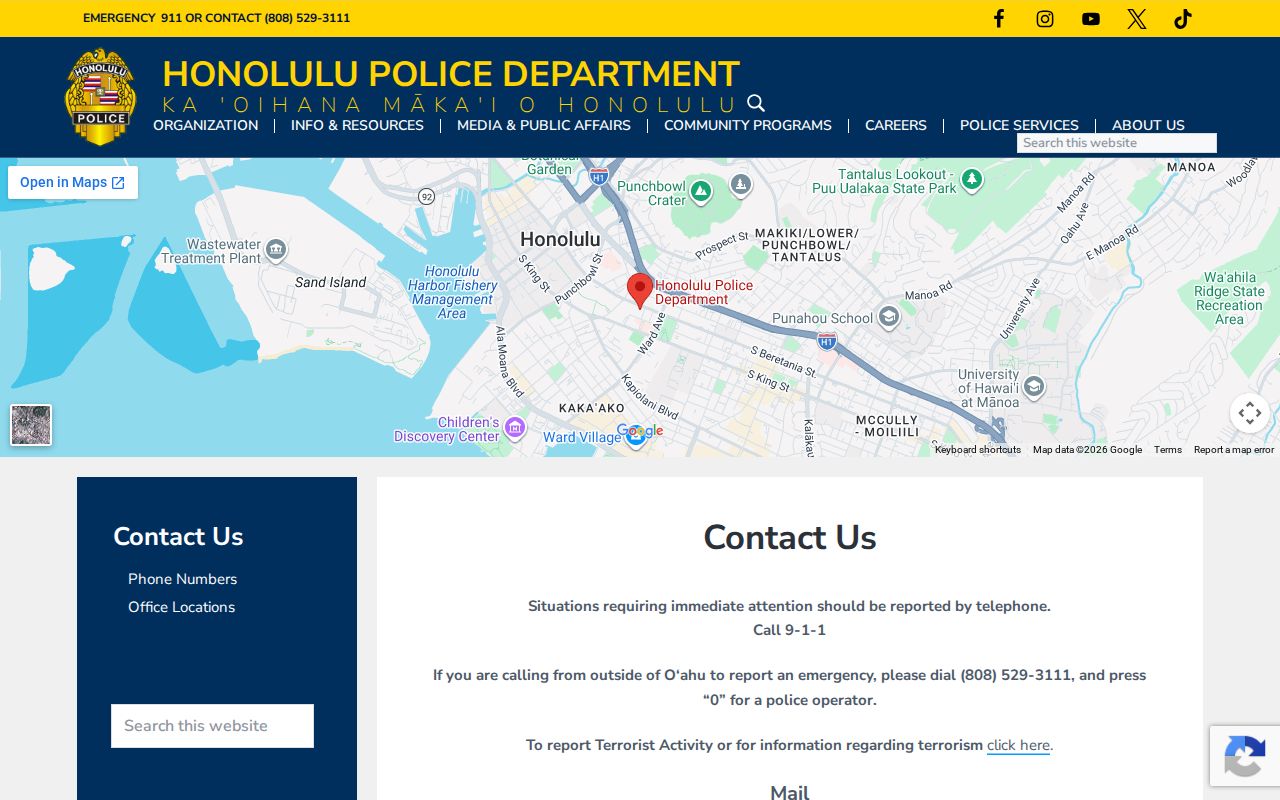
Central records handling explains why residents outside urban Honolulu still route report-copy work through Alapaʻi.
Requesting Honolulu Police Reports
A precise request saves time because the records unit must locate the correct event and review each part for release. The City’s UIPA form supports inspection or copies by email, mail, or in person. The requester can also state a cost limit so the agency can seek approval before work exceeds it.
| Request Field | What to Provide | Why It Matters |
|---|---|---|
| Requester details | Name, address, and contact information | Allows response and clarification |
| Event identifiers | Report number or date, time, place, and people | Locates the correct Honolulu event |
| Record description | Exact report, media, or portion sought | Defines the scope of review |
| Relationship | Connection or authorization | May affect what HPD can release |
| Delivery and cost | Inspection, format, and cost limit | Guides production and approval |
Note: An incident report records allegations and investigative steps; it is not proof that a prosecutor filed the same charge.
Booking and Arrest Records in Honolulu
HPD publishes timestamped arrest-log PDFs throughout the day. The filenames and posting times help a reader select the six-hour window around a recent event. The log can show an arrest date and time, location, district or division, offense text, statutory references, identifiers, and custody or release coding. It does not show whether the prosecutor later filed that charge.
For a deeper arrest search, open the PDFs on both sides of the known event time, then request the underlying HPD report. If charges are filed, use eCourt Kōkua for the prosecution. A same-day search can fail because police processing and court filing are separate steps. The city’s arrest channel is treated in more detail on the Honolulu County Arrest Search page.
Honolulu Bookings Reach State OCCC
HPD does not operate a city jail roster. Detainees who remain in custody are generally routed to the state-run Oʻahu Community Correctional Center, while others may be cited or released under the legal circumstances of the case. OCCC is at 2199 Kamehameha Highway and can be reached at (808) 832-1777. Hawaiʻi SAVIN/VINE is the public custody-status and notification route.
The official OCCC facility page identifies the institution and its Honolulu role.
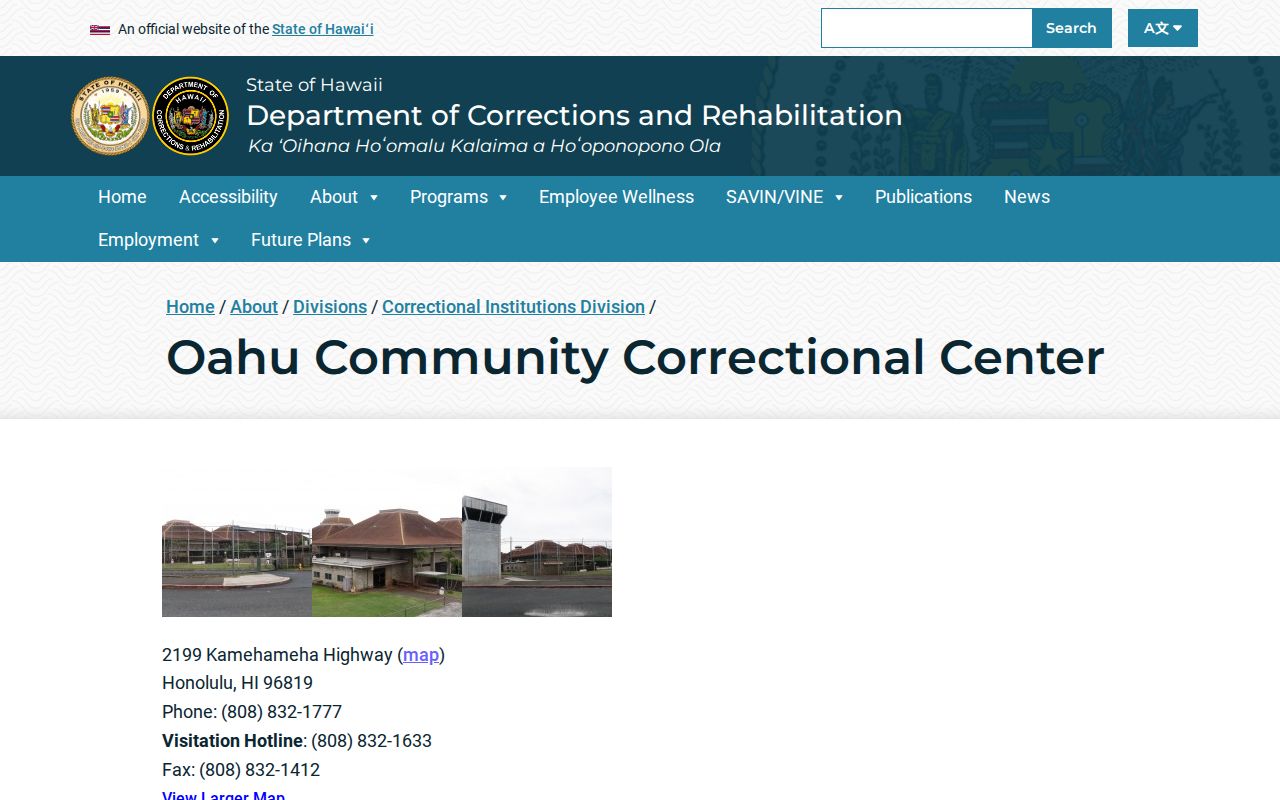
The image marks the custody stop, not the source of the court file or a complete Honolulu criminal history.
The Honolulu Municipal Court File
Honolulu has no municipal court separate from the Hawaiʻi State Judiciary. Kauikeaouli Hale, the Honolulu District Court of the First Circuit, handles misdemeanors, petty misdemeanors, traffic matters, and preliminary felony work. Kaʻahumanu Hale houses Circuit Court felony proceedings. Both systems feed eCourt Kōkua.
| Court Name | District Court and Circuit Court of the First Circuit, not a city municipal court. |
|---|---|
| Case Types | District Court handles misdemeanor, petty misdemeanor, traffic, and preliminary felony matters; Circuit Court hears felonies. |
| Lookup Channel | eCourt Kōkua by party name or case identifier, plus the courthouse counter for unavailable files. |
| Docket Contents | Parties, counts, statutes, events, pleas, dispositions, sentencing, and PDF links when available. |
| Copies | Online documents displaying a PDF icon may be purchased; courthouse and written-request options remain available. |
District criminal cases before August 2012 may not be online. Ask the District Court counter at 1111 Alakea Street when an older Honolulu file does not appear.
Searching Honolulu Court Records
At eCourt Kōkua, accept the disclaimer and select the correct District or Circuit criminal search. Enter the case identifier when available. A party-name search is useful when the number is unknown, but spelling and similar-name problems require care. Open the charge, party, and docket tabs, and read each count rather than relying on one overall status label.
A Honolulu arrest charge may differ from the count filed by the Prosecuting Attorney. The filed count may later be amended, dismissed, resolved by plea, tried, or acquitted. The court file is therefore the better source for the judicial outcome. Older migrated case identifiers sometimes require conversion to a 12-character format, and the Judiciary’s eCourt help page provides that route.
Case information may be free to view while an available document costs money to retrieve. Purchase links appear only for entries with a PDF icon. If the needed filing has no icon, note its docket title and date, then request it from the courthouse. This keeps a missing online document from being mistaken for a missing Honolulu case.
How Honolulu Records Reach the County
No single Honolulu counter owns the whole record. HPD creates the incident and arrest report. DCR records current custody at OCCC. The Prosecuting Attorney decides which count to pursue, and the First Circuit Judiciary creates the docket. Courts and prosecutors then report dispositions to HCJDC for the statewide conviction product.
Record flow: HPD arrest log › OCCC or SAVIN custody › eCourt Kōkua charging docket › HCJDC eCrim conviction record
Use the first source for recent police action, the second for present custody, the third for filed charges and disposition, and the fourth for a reported adult conviction. Timing gaps are normal. A blank result in one system does not prove that no event exists in another.
For a search of one's own history, the channels can be checked against identity documents and corrected at the source. HPD handles its report, the clerk handles the court file, and HCJDC handles the repository record. Fingerprint-based Access and Review is the strongest way to resolve a doubtful statewide name match.
Four Honolulu Criminal Record Counters
Downtown Honolulu packs several record offices into a small area, yet each has a separate job. “Go to the county courthouse” is not precise enough. Choose the counter by record type and confirm current office instructions before visiting.
HPD Records
801 South Beretania Street
Police reports and collision records
(808) 723-3000
District Court
1111 Alakea Street
Misdemeanor and traffic files
Legal Documents Branch on the third floor
Circuit Court
777 Punchbowl Street
Felony criminal files
(808) 539-4300
HCJDC
465 South King Street, Room 101
Criminal history services
(808) 587-3279
The City and County of Honolulu source reflects the consolidated government that links these local functions.
Honolulu Hale represents city government, but court, jail, and state repository files remain with their separate custodians.
Honolulu Record Access Rules
Public access depends on the holder and record type. UIPA governs city police requests, but exemptions can protect active investigations and private material. Chapter 846 controls criminal-history dissemination, so public eCrim information is limited to adult arrest information that resulted in conviction. Court dockets follow Judiciary access rules, and sealed or confidential cases can disappear from public search.
Key statutes:
HRS Chapter 92F governs access to government records and permits listed privacy and law-enforcement exceptions.
HRS Chapter 846 governs criminal-history information and limits public release of pending and non-conviction arrest data.
HRS §831-3.2 provides qualifying expungement relief and the current electronic-court transmission process.
Compare sources before drawing a conclusion. A police report can describe an allegation, a court docket can record a dismissal, and eCrim can omit the non-conviction arrest. Those results can all be accurate under the rules that govern each custodian.
Older Honolulu Cases May Be Offline
The First Circuit’s online coverage has a practical cutoff. Honolulu District Court criminal cases before August 2012 may require a courthouse search even when later cases appear in eCourt Kōkua. Missing PDF icons also mean the document itself is not available for online purchase, though basic case information may be visible.
Bring the party name, approximate filing date, known charge, and any old case number to the proper clerk. Circuit felonies belong at Kaʻahumanu Hale; District misdemeanors belong at Kauikeaouli Hale. This local split is more useful than asking for a generic Honolulu municipal record.